
AECT Standard 3
The World of Artificial Intelligence: An Online Course for 6th-12th Graders
Context and Conditions
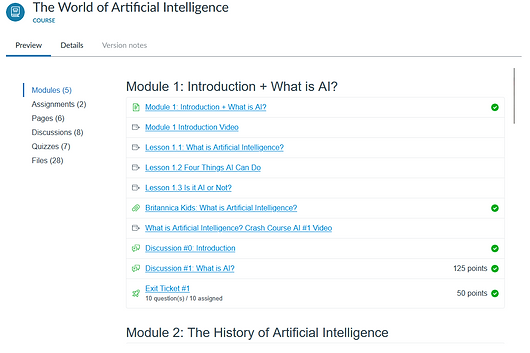
The World of Artificial Intelligence: An Online Course for 6th-12th Graders was designed and developed for EDET 755 in the summer of 2024 and was the first project I completed as part of my graduate studies in Learning Design and Technologies at the University of South Carolina. This artifact is a complete quarter-long, module-based asynchronous course, including all necessary instructional material, assessments, and assignments. The tools that were used in the creation of this artifact were Canvas LMS, Microsoft PowerPoint for course materials, and YouTube to host the lecture videos.
When this course was developed, I had not yet been formally introduced to any instructional design models such as MRK (Morrison et al., 2019) or ADDIE (Branch, 2009). Additionally, I had not studied any learning theories in depth. As such, most design decisions were made based on my experiences as a middle school computer science teacher who had taught the material previously and on my understanding of how students have engaged with similar content in the classroom in the past. For example, I designed the course using a weekly module structure with a consistent format, lecture videos, readings, and discussion activities to keep students engaged because I saw these as good online adaptations of activities I already do in the in-person classroom. I now understand that these decisions align with principles related to cognitive load theory (Sweller, 2024) and elements of the ADDIE and MRK models. While these frameworks were not intentionally applied at the time, this artifact shows an emerging and intuitive understanding of instructional design practices that I have more formally developed throughout the graduate program. This artifact in particular highlights how my early work was rooted in practical teaching experiences and how my understanding of instructional design has evolved to become more theory-driven and intentional.
Scope
Role
This artifact was created as part of an independent project. I was the instructional designer, lecturer, and SME for the project. I created the syllabus and all course materials and videos. Additionally, I found videos and articles that were used as supplemental instructional materials for students. It is also important to note that this course was based off a shorter unit that I currently teach in my eighth grade computer science class in my personal career. Many of the assignments and the final project were constructed from materials I developed outside of this program.
Instructional Design
This artifact reflects elements of the MRK model (Morrison et al., 2019), particularly in its focus on learner needs, instructional strategies, and formative evaluation. As someone who bears daily witness to middle schoolers’ interactions with technologies and AI, I was able to identify the need for students to understand artificial intelligence and its ethical implications. The learner characteristics were clearly defined in the course syllabus as sixth through twelfth grade students with no prerequisite knowledge on artificial intelligence, technology, or coding. Instructional strategies that were utilized include discussions, projects, readings, and videos, and all content was chunked and structured into modules. Additionally, formative evaluation was embedded into the course through discussion posts and student exit tickets.
Additionally, this artifact reflects elements of the ADDIE model (Branch, 2009) with strongest emphasis on the analysis, design, and development phases. Within the analysis phase, I identified the need for AI literacy among adolescents, and within the design phase, I created the course syllabus, wrote the course objectives, and aligned these objectives to the course activities and assessments. As part of the development phase, I used the Canvas LMS to implement the course, recorded lecture videos, and wrote assignments and assessments for students. Lastly, related to the evaluation phase, the course allows for feedback from students through formative assessments that measure student understanding and course effectiveness.
Related Performance Indicators
AECT Standard 3 (Learning Environments): Candidates facilitate learning by creating, using, evaluating, and managing effective learning environments.
Performance Indicators:
-
Creating - Candidates create instructional design products based on learning principles and research-based best practices
-
Assessing/Evaluating – Candidates use multiple assessment strategies to collect data for informing decisions to improve instructional practice, learner outcomes, and the learning environment
-
Managing – Candidates establish mechanisms for maintaining the technology infrastructure to improve learning and performance
Reflection
This artifact, as the first project I completed in graduate school, represents a very early stage in my development, and it primarily shows an emerging, intuitive approach to instructional design. When I created this course, I relied heavily on my experience as a middle school computer science teacher when structuring the course. This is evident in the use of weekly modules, discussion-based activities, and a final project that allows students to apply their learning. The course is well-organized and covers meaningful content; however, it does not consistently reflect intentional alignment between learning objectives, instructional strategies, and assessments. When compared to my later work in the program, this artifact demonstrates how my understanding of instructional design has evolved. At this point, I recognize the importance of conducting formal needs assessments, explicitly aligning objectives and assessments, and incorporating an instructional model like ADDIE or MRK. For example, this course includes a variety of assignments and activities, but they are not intentionally and individually mapped to specific learning objectives. This artifact also ties to elements of AECT Standard 3, as the course was designed as a structured online learning environment that encourages student engagement and participation and evaluates student performance.
If I were to revise this online course with my current knowledge and skills, I would make improvements such as incorporating low-stakes formative evaluations that serve as checkpoints within the modules. I would include more diverse and accessible instructional materials, and I would seek feedback from students to evaluate the effectiveness of the course in order to make iterative improvements. Overall, this artifact demonstrates my initial understanding of course design and is a valuable point of comparison for the more intentional practices I have developed throughout the course of this program.